
Sites and assets: what the technician will find when he arrives.
A site is not a line of address. It is a track, a gate, a guard, a code, a generator, a landowner to warn, and a history of work that explains today’s fault.
Everything you will not find anywhere else.
Access information always exists somewhere: in an old hand’s head, in a message, in a notebook. This module turns it into a reference attached to the site, kept up to date by the people who go there.
Location
Site coordinates, a small map, and the phone’s own navigation app opening directly. The map works with no key and no outside account.
Access instructions
Padlock code, badge to request, guard to call, track impassable after the rains, site opening hours. Readable before setting off.
Power
Grid, generator, solar, batteries. The power source shapes the diagnosis: an outage is not handled the same way from one site to the next.
Equipment
What is installed on the site and what has already been replaced. Past work on the same equipment is the most useful experience there is.
History
Every job on the site, in order. You see immediately whether the fault is recurrent and what was tried last time.
Current load
Open tickets per site, so the sites that cost money stand out at a glance and can be dealt with properly.
See the network, not a list.
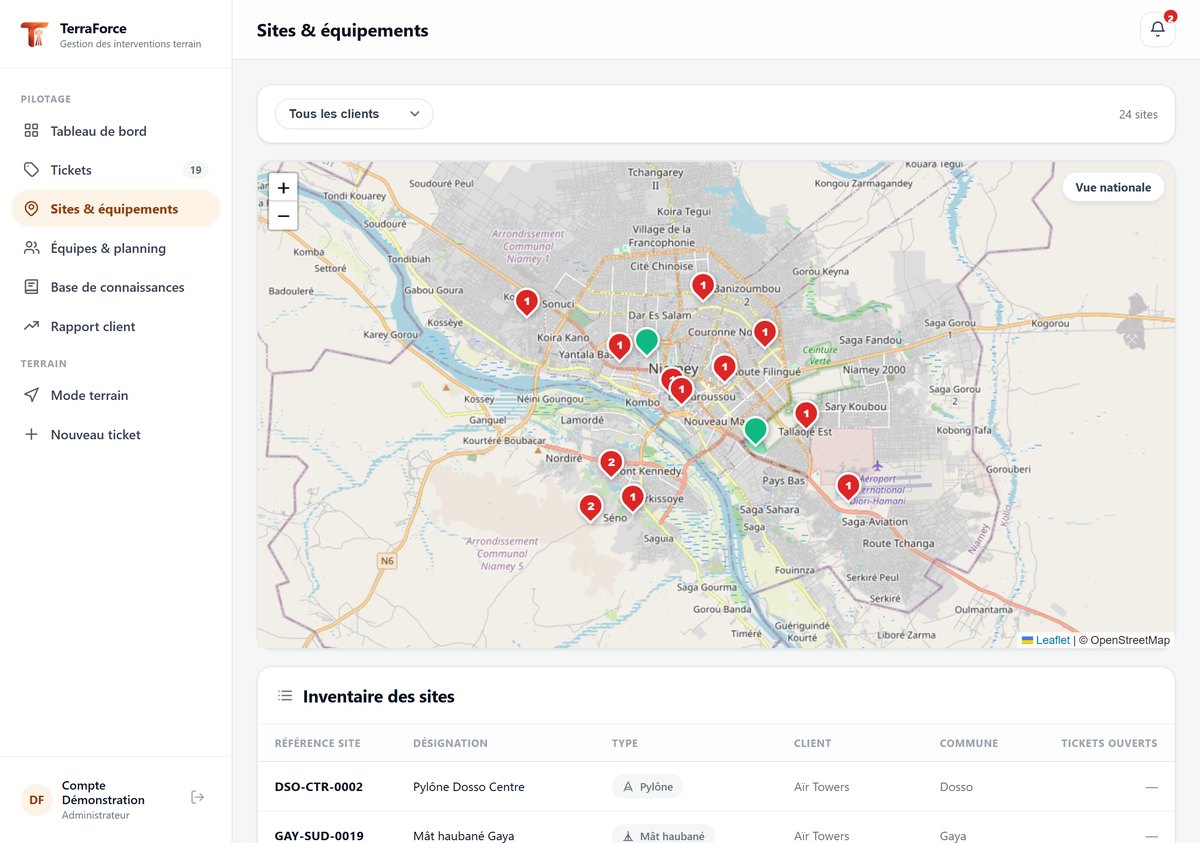
The map shows the sites in a region or across the country, with the state of open tickets. Dispatch uses it to group visits: a round of three neighbouring sites costs far less than three separate trips.
- Open map tiles, no interface key and no metered quota
- Switch between the regional view and the national view
- Direct access to the site record and its open tickets
- Deep links into the phone’s navigation apps
See the platform run on your own cases
An hour is enough: you open a request, assign it, close it and print the signed work order. Then we look at how your operation fits in: your customers, your sites, your contractual deadlines.